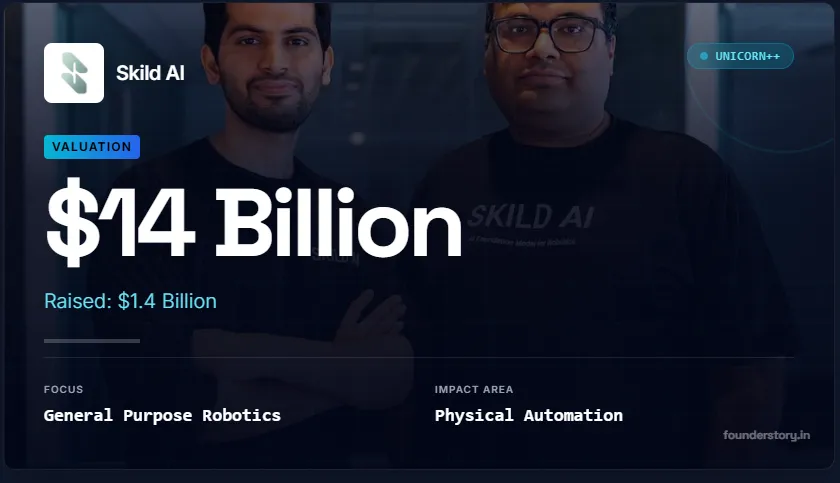
The robotics race just entered a new league. Skild AI, a company building the "brain" for general-purpose robots, has secured $1.4 billion in fresh capital, catapulting its valuation past the $14 billion mark.
This stands as one of the largest funding rounds ever in the robotics space, signaling a massive capital shift from digital generative AI (like LLMs) to Physical AI—machines that can navigate, learn, and act in the real world.
FounderStory Intelligence
Building a "General Intelligence" layer for robots to operate in unstructured environments, not just controlled labs.
Beyond the Factory Floor
Unlike traditional industrial robots that are pre-programmed to do one task repeatedly (like welding a car door), Skild AI is betting on general-purpose robotics. These are machines that can learn, adapt, and operate across real-world, unstructured environments—from a cluttered warehouse to a hospital corridor.
This capability is the "Holy Grail" of robotics. It shifts the value from the hardware (the metal arm) to the software (the intelligence layer), putting pressure on Big Tech and industrial giants to accelerate their own robot strategies.
"The question now isn’t if robots scale into everyday work but who controls the intelligence layer."
FounderStory Takeaway
Skild's raise confirms that the AI hype cycle is maturing into physical applications. For economies like India, which are pushing hard on manufacturing and logistics, the rise of intelligent automation presents both a challenge (labor displacement) and a massive opportunity (efficiency gains). The next trillion-dollar company might not be a software firm, but the one that teaches robots how to think.