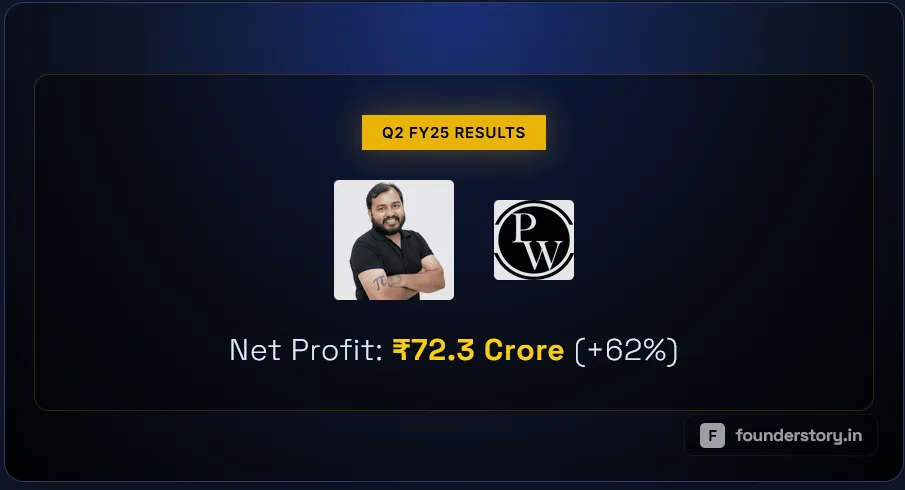
The numbers are in, and the "Alakh Pandey Effect" is real. In its very first quarterly report since listing on the bourses, PhysicsWallah (PW) has delivered a performance that stands in stark contrast to the rest of the struggling edtech sector.
For the quarter ended September 30, 2025 (Q2 FY25), the company reported a consolidated net profit of ₹72.3 Crore, a massive 62% jump year-on-year. Revenue from operations also surged 26% to ₹1,051 Crore. But these headline numbers only scratch the surface of what is effectively a masterclass in unit economics.
Company Intelligence
PhysicsWallah Private Limited (PW)
Regulatory Data
View MCA Master Data →
Website
pw.live
Social
LinkedIn Profile
Q2 FY25 Profit
₹72.3 Cr ▲ 62%
Part 1: The Financial Anatomy of a Winner
In a fiscal year where major competitors are still reporting thousand-crore losses, PhysicsWallah's books are boringly, refreshingly healthy. Let's break down the Q2 performance beyond the headline numbers.
| Metric | Q2 FY24 (Last Year) | Q2 FY25 (Current) | Growth (YoY) |
|---|---|---|---|
| Revenue | ₹832 Cr | ₹1,051 Cr | ▲ 26% |
| Net Profit (PAT) | ₹44.5 Cr | ₹72.3 Cr | ▲ 62% |
| Adjusted EBITDA | ₹191 Cr | ₹269 Cr | ▲ 41% |
| EBITDA Margin | 23% | 26% | ▲ 300 bps |
The most striking metric is the EBITDA margin expansion to 26%. This indicates "Operating Leverage" kicking in—a fancy finance term meaning that as PW adds more students, its costs (teachers, tech, rent) don't rise as fast as its revenue. Every new student is more profitable than the last.
Part 2: The "Phygital" Gamble That Paid Off
Two years ago, critics warned that PhysicsWallah's aggressive expansion into offline centers (Vidyapeeth) would kill its margins. Offline education is heavy on CapEx (rent, furniture) and OpEx (electricity, staff). Yet, the Q2 results prove the opposite.
Offline enrollments grew by 26% to 0.40 million students. But here is the secret sauce: Customer Acquisition Cost (CAC).
Legacy coaching institutes spend nearly 20-30% of their revenue on marketing (full-page newspaper ads). PW spends a fraction of that because its funnel is fed organically by its YouTube channel (125M+ subscribers across channels). Students watch free videos online, build trust with "Alakh Sir," and then walk into a Vidyapeeth center for the premium experience. It is a funnel that competitors simply cannot replicate with VC money.
"We are building for the students of Bharat. Our focus remains on outcomes, not just enrollments. The 17.2% EBITDA margin is a testament to our operational discipline."
— Prateek Maheshwari, Co-Founder
Part 3: Beyond JEE/NEET – The Diversification Game
PhysicsWallah is no longer just a test-prep company. The Q2 earnings call highlighted significant traction in new verticals:
- PW Skills: Their upskilling vertical for coding and data science is growing rapidly, targeting the post-college demographic that needs job-ready skills.
- Study Abroad: A high-ticket segment traditionally dominated by expensive consultants. PW is disrupting this with affordable counseling and GRE/GMAT prep.
- UPSC & Govt Exams: Entering the massive government job prep market puts them in direct competition with players like Adda247, but PW's brand recall gives them a head start.
- School Integration: The company is now embedding its curriculum directly into schools, securing long-term B2B revenue streams.
Part 4: The "Anti-Edtech" Edtech
To appreciate PW's success, you have to view it against the backdrop of the industry's implosion.
The Old Playbook (Byju's/Unacademy)
- Sell hardware (tablets/SD cards).
- Aggressive sales force (pushy tactics).
- High CAC (Celebrity endorsements).
- Growth fueled by continuous fundraising.
The PW Playbook
- Content-first (YouTube organic reach).
- Pull-based demand (students come to them).
- Affordable pricing (democratizing access).
- Growth funded by internal accruals (profits).
PhysicsWallah didn't just win by being cheaper; they won by being culturally aligned with the aspirations of middle-class India. They understood that for a student in a tier-3 city, education isn't a luxury product—it's a lifeline.
FounderStory Takeaway
As PhysicsWallah trades at a healthy premium post-listing, it sends a signal to the entire startup ecosystem: Profitability is cool again.
Alakh Pandey and Prateek Maheshwari have shown that you don't need to burn cash to build a brand. You need community, trust, and a product that solves a genuine problem at a price point India can afford. As they look to FY26, the challenge will be maintaining this culture of frugality while managing the pressures of being a publicly traded company. But for now, they are the undisputed valedictorians of the class of 2025.