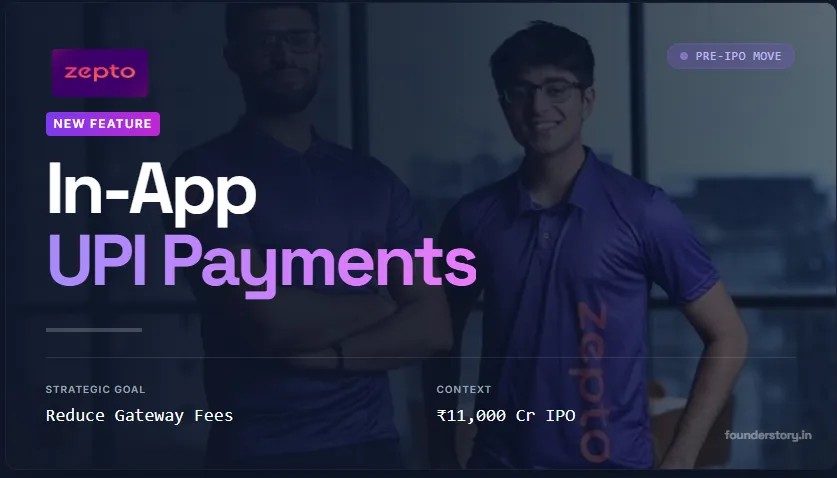
Zepto has made a bold strategic maneuver just as it files its IPO papers with SEBI. The quick commerce unicorn has launched its own in-app UPI payment feature, a move designed to reduce reliance on third-party giants like PhonePe and Google Pay.
Following in the footsteps of Swiggy and Zomato, Zepto's integration allows users to complete transactions directly within the app without redirecting to external UPI apps. This frictionless experience is crucial for a business model where every second of delivery—and checkout—counts.
Strategy Sheet: Zepto Pay
Why Build Your Own UPI?
For a company planning to raise ₹11,000 crore ($1.3 billion) via an IPO, unit economics are everything. The move to a native UPI stack solves three critical problems:
- Payment Gateway Fees: Every time a user pays via an external app, Zepto pays a small fee (MDR) to the gateway. By becoming a Third-Party Application Provider (TPAP), they can significantly reduce these recurring costs.
- Checkout Drop-offs: Redirecting to PhonePe or GPay adds friction. Often, transactions fail during the handoff (app switching latency). In-app UPI keeps the user within the Zepto ecosystem, creating a "One-Click" experience.
- Data Ownership: Owning the payment layer gives Zepto granular data on user spending habits, which is invaluable for credit offerings or loyalty programs post-IPO.
The Unit Economics: Why 0.5% Matters
To the average user, paying via Zepto UPI vs. Google Pay feels identical. To Zepto's CFO, it is a game-changer.
In high-frequency businesses like Quick Commerce, margins are razor-thin (often single digits). Payment processing fees typically eat up 1.5% to 2% of the transaction value. By bypassing third-party aggregators and routing transactions directly via NPCI's plugin framework, Zepto can potentially save 30-50 basis points (0.3% - 0.5%) per transaction.
On a Gross Merchandise Value (GMV) of $1 Billion, a 0.5% saving translates to $5 Million in pure bottom-line profit annually. For public market investors scrutinizing profitability, this is found money.
Tech Under the Hood: The Plugin Model
Zepto is likely leveraging the NPCI Plug-in model (similar to Swiggy and Zomato). Unlike a full-blown UPI app (like Cred or PhonePe) which requires a separate app license, the plug-in model allows merchants to embed a "Virtual Payment Address" (VPA) handle creation flow directly inside their shopping app.
This means you don't download "Zepto Pay." You simply link your bank account inside Zepto once, and future payments happen without ever leaving the app interface.
What's Next? The Fintech Roadmap
History suggests that payments are just the gateway drug. Once Zepto owns the transaction layer, the roadmap opens up to high-margin financial products:
1. Zepto Pay Later (BNPL)
With data on your grocery buying habits (e.g., spending ₹5,000/month consistently), Zepto is better positioned to underwrite a small credit line than a bank. Offering a "Buy Now, Pay End of Month" tab for groceries increases Average Order Value (AOV).
2. Co-Branded Credit Cards
Swiggy has the HDFC card. Zomato has the RBL card. It is almost inevitable that Zepto will launch a co-branded credit card offering 5-10% cashback on groceries, locking in user loyalty and earning interchange fees.
"Zepto will have full control over its payments infrastructure... this will help reduce payment gateway fees, improve conversion, and reduce third-party dependency."
FounderStory Takeaway
In the high-volume, low-margin game of quick commerce, fintech is the secret sauce for profitability. Just as Zomato and Swiggy realized, you cannot let a third party own the most critical part of the funnel—the payment. Zepto's move isn't just about convenience; it's about asset control in a public market narrative. By the time the IPO bell rings, Zepto won't just be a grocery app; it will be a fintech disguised as a delivery boy.